Friday, 29 July 2016

Rhubarb Schnapps

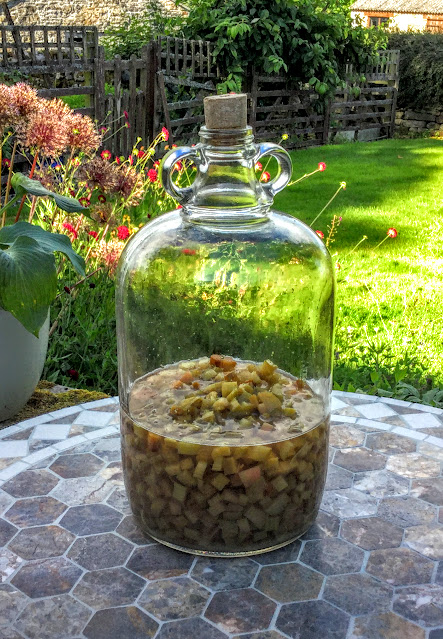
We have made several fruit liqueurs in the past - damson and sloe gin and cherry brandy. They are very popular amongst my friends as an after dinner drink. Last year, at the suggestion of my sister, we tried rhubarb schnapps. I used a Nigella recipe, but found it to be a bit weak and insipid. This year, I'm experimenting!

1. 1kg rhubarb, chopped very finely. I froze this overnight, which has the effect of breaking open the cell walls and allowing the juice to escape. This was far too much rhubarb, but I had loads in the garden - 500g would have been plenty. 

2. Next day, I put the rhubarb into a demijohn, with 200g sugar, and 750ml vodka. I used Sainsbury's standard vodka. I'll taste after about a month, and see if it needs more sugar.


3. I kept this in a cool place, out of direct sunlight, shaking every day for a week (ensuring that all the sugar is dissolved after this time), then every week until the autumn, when I'll strain off the liquid, back into the vodka bottle. 

I'll keep you posted, and look forward to a sip later in the year.
Wednesday, 29 June 2016

May in the Garden


We continue to find hidden beauties. Tulips .....


.... daffodils still in bloom after those in Yorkshire are long gone ....


.... yellow daisies ....


.... four different magnolia; one not so photogenic this year ....


.... spiky - any idea what this is ....


.... berberis ....


.... acer ....


.... unidentifed foamy blue plant ....


.... redcurrants in abundance ....


.... tiny medlar .... 


.... next door's duck on the pond, keeping down the slugs and snails ....


.... so that we can grow hostas ....


.... and I leave you with a May posy


Wednesday, 15 June 2016

Teesdale Spring Flowers

We took a drive up the dale and parked near the Cow Green Reservoir. This is on the Moor House-Upper Teesdale National Nature Reserve, 8800 hectares of upland and part of the Upper Teesdale Area of Outstanding Natural Beauty (AONB). It was a beautiful sunny afternoon, as we set off along the footpath alongside the reservoir.

Once we were away from the car parks we saw nobody, apart from one man walking the Pennine Way. He was walking north and planning to pitch his tent for an overnight stay on the moor.

Teesdale is well known amongst botanists for the Teesdale Assmeblage, a group of some 20 plants found in this area. We were absolutely delighted to spot the Teesdale spring gentian, Teesdale violet and mountain pansy.


As we looked across the reservoir we saw the Great Dun Fell radar station, and Cross Fell, the highest point in the Pennines. There were sheep, and we were lucky enough to spot Black grouse and their chicks. This is the weather station, measuring the effects of climate change on upland flora and fauna. 


It was a pleasant walk down to the Cow Green Dam, followed by a scramble over boulders to see Cauldron Snout. This is the longest waterfall in England, though due to its more isolated position,  less well known than the nearby High Force. 


2 June 2016

Tuesday, 7 June 2016

Curlew Country

We went for a look at Holwick, from where you can walk across fields to High and Low Forces. Today, we decided to walk up a hill, and take in the view. We were able to look down to Holwick Lodge, country home of Lord Strathmore.


We could hear the curlew, but were astonished and delighted to come across this curlew chick, hiding in the grass. Quick photo before we left him and his mum to the moor.


We'll be back to Holwick another time, and pay a visit to the Strathmore Arms. 

2 June 2016

Wednesday, 1 June 2016

Kirkcarrion is So Bracing

Kirkcarrion, or Caryn's Castle, or Kirk Arran is a well known landmark in Teesdale, and is visible for miles around.


It's a copse of pine trees, surrounded by a low stone wall, atop a hill. The trees are over a tumulus, said to contain the grave of Caryn, a Bronze Age chieftan. In 1804, a farmer used some of the stones to build a wall. subsequently, local landowner, Lord Strathmore, removed many of the grave goods to his home, near Barnard Castle. As a mark of respect, he built the walls around the burial mound at Kirkcarrion, and planted the trees. It is believed that this did not appease Caryn, whose ghost is said to haunt the place still.

Local tradition says it's lucky to climb the hill on Mayday morning; we were a couple of weeks late, but the walk is none the less spectacular for that.

 We parked the car on a side road, and took the footpath up from just outside Middleton.


Soon we were onto open access moorland, so just walked up the hill heading for the trees. We saw plenty of Swaledale sheep, and some curlew; my first sighting close-up.


It was blowing a hoolie, so we raced for the summit, but once among the trees, we could appreciate the views; looking over into Lunedale, with good views of Grassholme reservoir.


Thursday, 26 May 2016

Goose Eggs

Our neighbour gave us a brace of goose eggs.


The goose eggs are significantly bigger than a hen's egg; 175g to 60g. The shells are very thick too - I scored around with a serrated knife before cracking. Out of interest, I weighed the shells; 20g to 5g.


The goose egg yolk is very large in relation to the white, giving an even yellower colour to the whisked eggs.


We've never eaten goose eggs before, so put one of them into a quiche, with asparagus and leeks from the Yorkshire garden, and supplemented with a couple of our hen's eggs. I wondered if they might taste a bit "gamey" but couldn't taste and difference. Delicious!

Saturday, 21 May 2016

A Flock in the Field

We arrived home to find a flock of Swaledale sheep in the field!


The previous owners had an arrangement with a local farmer to graze his flock here, and until we're in a position to put our own animals on the land, it makes sense for us to continue. He's going to teach us a bit about shepherding in return. I tried to count, but they wouldn't stay still, so our best estimate is 10 ewes and 21 lambs.


* with apologies to Kenny Rogers and Lucille